

×
Skip to product information

FIZIK Transiro Aeris Adaptive Long Distance R3 Saddle

Black
Regular price €259,99
Regular price €259,99 Sale price €259,99
Tax Included
EU Destination Selected (Spain)

Out of stock

The essentials

Best for

  • Triathlon
FIZIK Transiro Aeris Adaptive Long Distance R3 Saddle - Black

Technologies

Specifications

ShapeSplit nose (Fizik)
Length242 mm
Width135 mm
Weight (Fizik)220 g (135 mm)
RailsKium 7x7 mm
ShellCarbon reinforced nylon shell
PaddingAdaptive
Height at 75 mm50 mm

Split nose

These saddles, as the name suggests, have a nose that’s split into two halves, providing support to the pubic rami as well as the greatest soft tissue pressure relief when sitting all the way forward on the tip of the saddle. They are specifically designed for long-distance triathletes that need firm support and balance for long hours spent in the aero riding position.

3D-printed Padding

3D-printed Padding

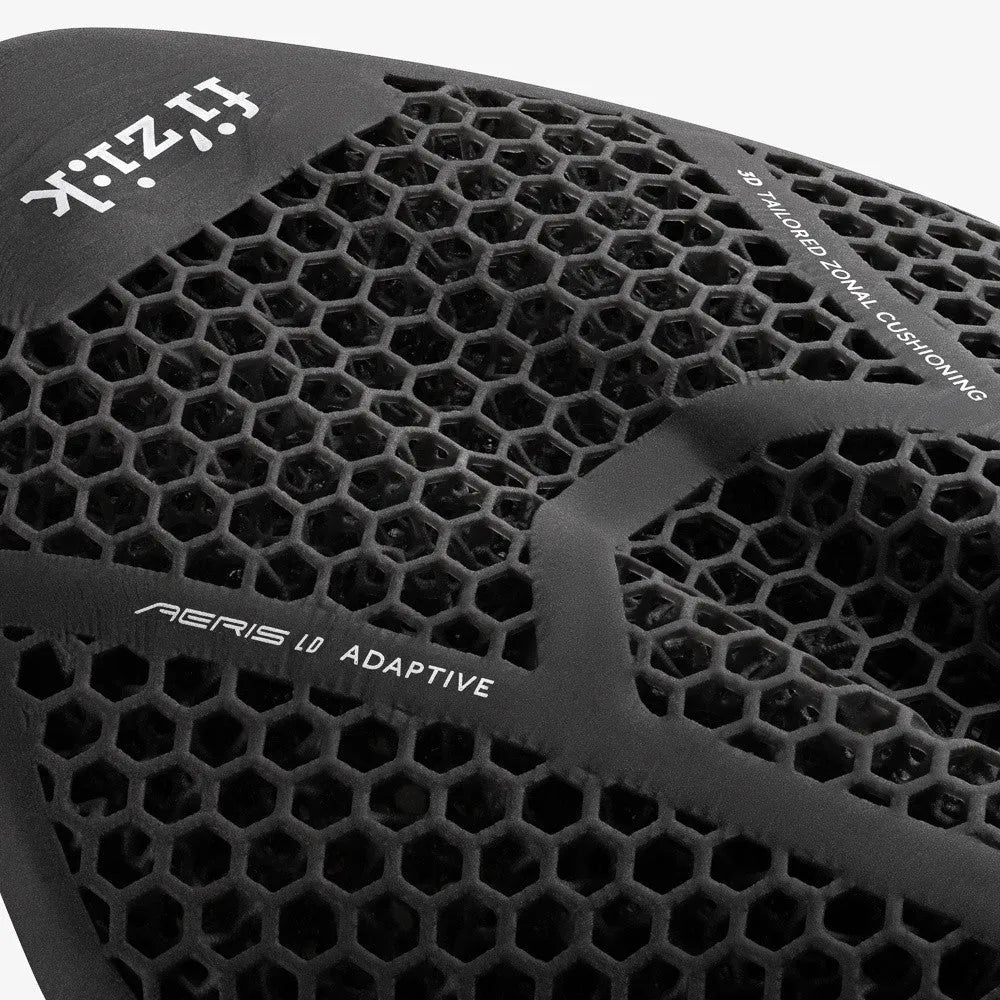
Fizik Adaptive 3D-printed padding has expanded to the Aeris family, creating the perfect match for those who want exceptional, long-lasting comfort on a triathlon bike saddle designed with a wider nose to provide greater support and stability when riding in forward, aerodynamic racing positions.

Tailored Zonal Cushioning

Tailored Zonal Cushioning

The evolution of digital 3D printing has allowed Fizik to develop a new saddle without the constraints or limitations imposed by traditional production methods and materials. The Adaptive saddle padding is crafted by Carbon® using their revolutionary Digital Light Synthesis™ technology. DLS is an additive manufacturing process which uses digital ultraviolet light projection, oxygen permeable optics, and programmable liquid resins to produce parts with excellent mechanical properties, resolution, and surface finish.

Lab Tested, Road Proven

Lab Tested, Road Proven

Using Carbon technology, biomechanics and engineers have an unprecedented possibility: to design and manufacture multiple functional zones within the saddle, tuning each of them separately for specific mechanical properties. Each of these key functional zones is engineered for a distinctive cushioning and mechanical response, joined together progressively and seamlessly in the same padding. The result? A 60% reduction in peak pressure through improved weight distribution for increased comfort across the entire saddle surface.

Fast And Forward Thinking

Fast And Forward Thinking

Innovation in bike-fitting analysis alongside research on cycling aerodynamics led Fizik to rethink Fizik’s triathlon and time-trial saddles. In a field where marginal gains are fundamental, being able to provide a saddle that allows comfort in the most extreme aerodynamic positions represents a leap forward in performance achievement.

The Adaptive Advantage

The Adaptive Advantage

The Long-Distance version of Aeris Adaptive is engineered with a wider nose and a long, deep channel that allows for unprecedented pressure relief, all while continuing to maintain the firm support and balance needed for long hours spent pushing in aero positions. At the nose, the rail loop provides added strength to avoid asymmetrical fatigue and also acts as a hook to hold the bike in place in race transition zones. One of the many benefits of Adaptive technology is that it allows Fizik to incorporate a channel, rather than a cut-out, with a soft central functional zone, improving weight distribution for better pressure relief to increase comfort on longer rides in aero positions. At the same time, the surface of the padding offers a no-slip grip that avoids unnecessary movement which can compromise performance.

Multiple Features For Mixed Disciplines

Multiple Features For Mixed Disciplines

Aeris comes with an optional link to integrate a water-bottle cage onto the rear of the saddle. The link is designed to hold bottles at an angle that is out of the way during the critical mounting and dismounting phases at transition zones. Complying with UCI rules, Aeris is equipped with a revolutionary rail insertion that not only provides a more aero feeling but also allows for a broad range of adjustability, necessary to achieve the ideal forward position to beat the wind. Aeris R3 Adaptive provides both strength and weight savings with the combination of a ride-compliant carbon-reinforced nylon shell and hollow Kium rail.

FIZIK Transiro Aeris Adaptive Long Distance R3 Saddle - Black

Frequently asked questions

Answered from this product’s published information. Questions about orders or anything else go to our team.

Which Fizik saddle suits my riding?

Fizik’s saddle guide starts from how you ride: Road Racing: Antares, Arione, Vento Argo; Road All Round: Aliante, Tempo Argo; Time Trial: Aeris SD, Arione; Triathlon: Aeris SD, Aeris LD; Gravel Racing: Argo X, Antares; Gravel All Round: Terra Argo, Aliante; MTB XC Racing: Argo X, Antares; MTB Trail: Aidon, Ridon, Terra Alpaca; MTB Trail E-bike: Aidon, Ridon; MTB Gravity: Ridon, Terra Alpaca, Gravita Alpaca.

What do Fizik’s saddle shapes (T-shape, V-shape…) mean?

T-shape (Antares, Arione): Saddles in this group have an abrupt nose-to-wing transition, resulting in a longer nose. Additionally, they also have a flatter profile. This provides more inner-leg clearance as well as multiple comfortable fore-to-aft sitting positions. T-shape saddles give riders the ability to easily alter their sitting position during the ride, moving towards the nose when adopting a more forward, aerodynamic riding position and moving back when riding more upright. That’s why it’s a popular choice for proficient riders and racers. V-shape (Aliante): These saddles flare from the nose to rear more gradually, like an arrowhead or a pear. They usually have a waved side profile, too. The sloping tail cradles the lower back while the gradual taper assists the rider with pelvic rotation, bringing them more forward. Because of these factors, V-shape saddles suit riders in need of extra support and comfort as well as those who enjoy long-distance riding. Short nose (Vento Argo, Tempo Argo, Terra Argo, Argo X, Aeris SD, Aidon, Ridon, Terra Alpaca, Gravita Alpaca): With a much shorter nose, these saddles provide a more defined area for where to sit, typically in combination with generous ischial support. As a result, riders are more planted on the seat and move around less, prioritizing stability and better weight distribution. This is Fizik’s most versatile saddle shape, which is why Fizik offers it in many options to suit different riding disciplines and styles. Split nose (Aeris LD): These saddles, as the name suggests, have a nose that’s split into two halves, providing support to the pubic rami as well as the greatest soft tissue pressure relief when sitting all the way forward on the tip of the saddle. They are specifically designed for long-distance triathletes that need firm support and balance for long hours spent in the aero riding position.

What’s the difference between Fizik’s 00, R1, R3 and R5 saddles?

Beyond style and shape, the next consideration to take into account is the saddle platform. The platform is the structural part of the saddle, consisting of the shell and rail, which Fizik offers in four distinct combinations, ranging from the lightest and stiffest to the most versatile and affordable. 00: Carbon (7x9) rails, High-module full carbon shell — A combination of a carbon rail and a high-module, full-carbon shell for unrivaled stiffness and weight savings. R1 / X1: Carbon (7x9) rails, Carbon-reinforced nylon shell — A combination of a highly stiff carbon rail and a ride-compliant, carbon-reinforced nylon shell for responsiveness and comfort. R3 / X3: Kium hollow (7x7) rails, Carbon-reinforced nylon shell — A combination of a Kium hollow rail with a high strength-to-weight ratio and a ride-compliant, carbon-reinforced nylon shell. R5 / X5: S-Alloy (7x7) rails, Carbon-reinforced nylon shell — A combination of an S-Alloy rail and a ride-compliant, carbon-reinforced nylon shell for reliable performance at an approachable price.

Which Fizik saddle width should I choose?

Fizik lists each saddle’s widths and weights in its spec table (shown on this page) but publishes no sit-bone rule for choosing between them. Widths by family: Vento Argo and Vento Antares 140/150 mm; Tempo Aliante 145/155 mm; Terra Argo 140/150/160 mm; Arione 135/145 mm; Transiro Aeris 135 mm. A sit-bone measurement or a saddle fitting in store is the reliable way to choose.

What is Fizik Adaptive padding?

Fizik’s most advanced 3D-printed padding, engineered with distinctive zonal cushioning and tuned to adapt to the rider’s body. Fizik makes it with Carbon®’s Digital Light Synthesis™ 3D printing, tuning separate zones of the padding for different cushioning.

SIZE

Description

A supportive racing saddle for long-distance triathlon events, designed to provide comfort in the most extreme aerodynamic riding positions and powered by Fizik’s innovative 3D-printed padding. Aeris LD Adaptive is a triathlon saddle featuring a wider nose and Fizik’s 3D-printed Adaptive padding to provide greater support and stability in long races when riding in forward, aerodynamic positions.

  • Split nose saddle — Triathlon in Fizik’s saddle guide
  • Kium 7x7 rails, Carbon reinforced nylon shell
  • Adaptive padding
  • Weight 220 g (135 mm), per Fizik

Available sizes

  • 135mm — EAN 8021890590138 · SKU 70g5d00a1p002

COMPLETE YOUR LOOK

View full details
FIZIK Transiro Aeris Adaptive Long Distance R3 Saddle - BlackFIZIK Transiro Aeris Adaptive Long Distance R3 Saddle - Black